
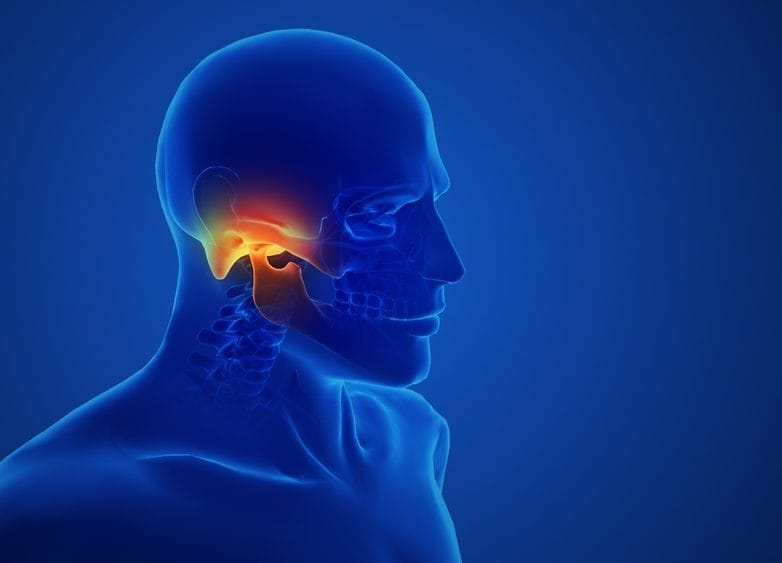
Temporomandibular joint disorders (TMD) affect every culture on every continent. 31% of adults worldwide may experience symptoms in their life.[i] These vary: some may hear a popping noise when moving the jaw, others may feel pain when masticating chewing, and others may be unable to fully open their mouth.[ii]
TMD patients can be managed in a variety of ways, depending on the severity of their symptoms. Those reporting pain are advised to eat soft foods, hold ice/heat packs to the sensitive area, and massage the jaw muscles. If these solutions fail to reduce pain, temporomandibular joint reconstruction (TMJR) may be needed.
TMJR is an advanced and infrequent treatment. However, it is capable of transforming a patient’s life by reducing pain and restoring function. There are two common approaches: autologous tissue transplantation, and alloplastic joint replacements.
Autologous tissue transplantation is the movement of bone from one part of the body to another. In TMJR, bone tissue may be taken from places like the rib, the fibular or the pelvis.[iii] This is then moved to the TMJ where the new tissue replaces the old. The main advantage of this is that it is biocompatible: as it is from the same body, there is minimal chance of rejection.
The drawbacks of tissue transplantation are that more surgery is required to get the bone tissue and there is the potential for resorption and extended surgery duration.[iv] The growth patterns of the new bone tissue can also be unpredictable and additional surgery may be needed in the future. These considerations can make the treatment less appealing to TMD patients.
An alloplastic joint replacement is a more innovative alternative that uses a prosthesis to replace the TMJ. These offer fewer complications and the risk of re-operation is also lower.[v]
There are two types of alloplastic devices: stock-type and custom-designed. The latter are produced using CAD/CAM technologies for a tailored fit.[vi] Alloplastic devices offer greater effectiveness than autologous transplantation – those treated with one experienced improved quality of life over a 12-year period.[vii] This included maximum mouth opening and superior mastication.
The use of titanium in these devices supports a solution that is biocompatible and long lasting, with a minimised risk of rejection.[viii] Titanium alloys enhance these qualities without compromising on strength or wear-resistance too.
Patients who have received TMJ reconstruction surgery will need rehabilitation in order to improve range of motion and jaw strength. Clinicians can support TMD patients by recommending the OraStretchâ Press Rehab System from Total TMJ. An easy-to-use device perfect for both home and travel, it stretches the orofacial tissues to restore strength and function to the TMJ. Patients can feel empowered in their recovery due to the notable improvements in mouth movement when following the daily exercises as recommended by a healthcare professional.


Having a stronger understanding of the different reconstruction approaches allows clinicians to better support their patients and ensure that they feel confident in their recovery of the TMJ.
For more details about Total TMJ and the products available, please email info@totaltmj.co.uk
[i] Wroclawski, C., Mediratta, J.K. and Fillmore, W.J. (2023). Recent Advances in Temporomandibular Joint Surgery. Medicina (Kaunas, Lithuania), [online] 59(8), p.1409. doi:https://doi.org/10.3390/medicina59081409.
[ii] NHS Choices (2020). Temporomandibular disorder (TMD). [online] NHS. Available at: https://www.nhs.uk/conditions/temporomandibular-disorder-tmd/.
[iii] Liu, H., Huang, L., Liu, S., Liu, L., Li, B., Zheng, Z., Liu, Y., Liu, X. and Luo, E. (2025). Evolution of temporomandibular joint reconstruction: from autologous tissue transplantation to alloplastic joint replacement. International Journal of Oral Science, [online] 17(1). doi:https://doi.org/10.1038/s41368-024-00339-3.
[iv] Liu, H., Huang, L., Liu, S., Liu, L., Li, B., Zheng, Z., Liu, Y., Liu, X. and Luo, E. (2025). Evolution of temporomandibular joint reconstruction: from autologous tissue transplantation to alloplastic joint replacement. International Journal of Oral Science, [online] 17(1). doi:https://doi.org/10.1038/s41368-024-00339-3.
[v] Liu, H., Huang, L., Liu, S., Liu, L., Li, B., Zheng, Z., Liu, Y., Liu, X. and Luo, E. (2025). Evolution of temporomandibular joint reconstruction: from autologous tissue transplantation to alloplastic joint replacement. International Journal of Oral Science, [online] 17(1). doi:https://doi.org/10.1038/s41368-024-00339-3.
[vi] Olate, S., Ravelo, V., Huentequeo, C., Parra, M. and Unibazo, A. (2023). An Overview of Clinical Conditions and a Systematic Review of Personalized TMJ Replacement. Journal of Personalized Medicine, 13(3), p.533. doi:https://doi.org/10.3390/jpm13030533.
[vii] Liu, H., Huang, L., Liu, S., Liu, L., Li, B., Zheng, Z., Liu, Y., Liu, X. and Luo, E. (2025). Evolution of temporomandibular joint reconstruction: from autologous tissue transplantation to alloplastic joint replacement. International Journal of Oral Science, [online] 17(1). doi:https://doi.org/10.1038/s41368-024-00339-3.
[viii] Silva, R.C.S., Agrelli, A., Andrade, A.N., Mendes-Marques, C.L., Arruda, I.R.S., Santos, L.R.L., Vasconcelos, N.F. and Machado, G. (2022). Titanium Dental Implants: An Overview of Applied Nanobiotechnology to Improve Biocompatibility and Prevent Infections. Materials, 15(9), p.3150. doi:https://doi.org/10.3390/ma15093150.